Most generative engine optimization frameworks lead with the wrong layer. They open with AI-specific schema, content chunking, or proprietary acronyms. The 66th runs a different framework with our clients. Three layers, built bottom up, the same engine that produces Google rankings produces AI citations. The piece below is the framework, the order, and why the order matters.
TL;DR
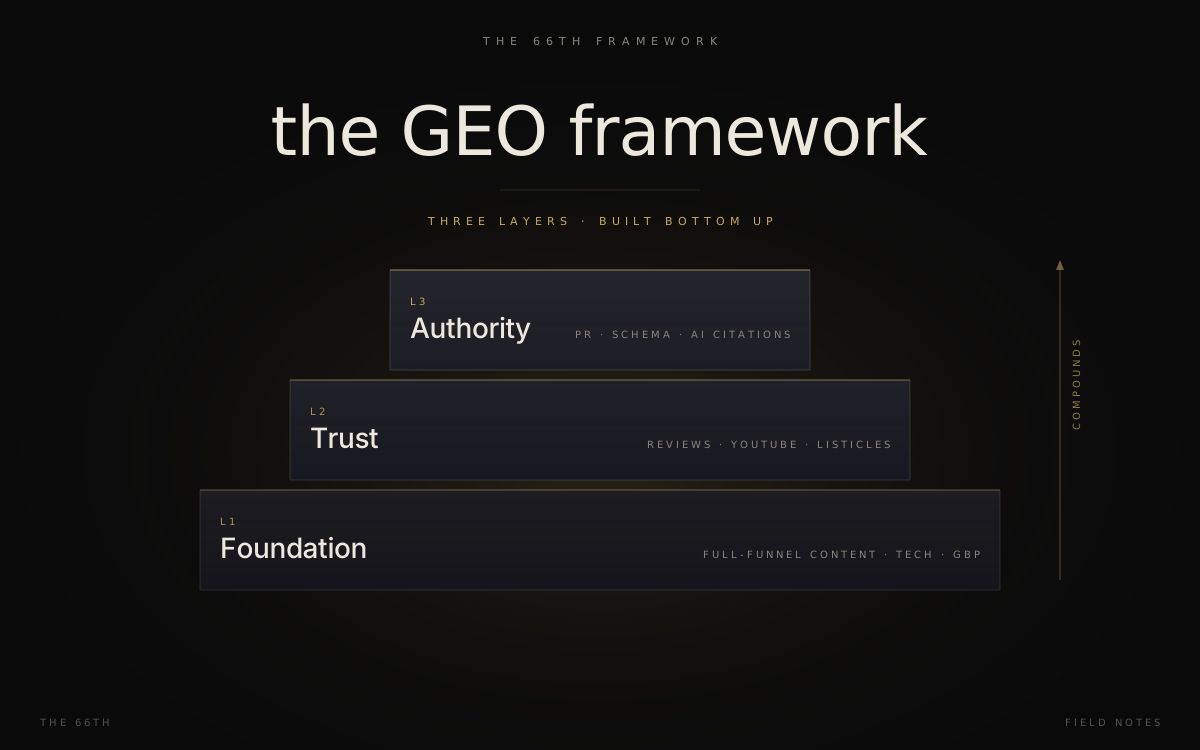
The framework is a three-layer stack. Layer 1 Foundation. Layer 2 Trust. Layer 3 Authority. Each layer compounds the one above it.
Layer 1 carries most of the work and most of the AI citation outcome. Full-funnel useful content, technical SEO, on-page fundamentals, Google Business Profile.
Layer 2 is the accelerant. Review velocity, YouTube and social presence, listicle and roundup pickups. The signals that move sentiment and trust.
Layer 3 is the byproduct. PR mentions, schema, Reddit threads, AI citations themselves. Most frameworks sell this layer as the entry point. We treat it as outcome.
The framework is bundled, not split. GEO and SEO share the engine. No separate GEO line item on a 66th invoice.
The framework, in one sentence
The framework is the SEO and GEO Pyramid. Three layers. Built bottom up. Each layer earns the layer above it. We run the same framework with every client because the work that ranks pages on Google is the same work that earns brand citations in ChatGPT, Perplexity, Claude, Gemini, Copilot, and Google AI Overviews.
Liam frames it like this: "GEO does not replace SEO. The foundation is high-quality, well-structured content that search engines already reward. AI citation systems pull from the same pool. If a page is not ranking, it is not getting cited either."
If you have already read the foundational piece on what generative engine optimization actually is, this piece is the operating model under that thesis. Below is the layer-by-layer scope of work, who owns it, and what the buyer sees in the report.
Layer 1: Foundation, the load-bearing layer
Layer 1 carries most of the work and most of the outcome. If Layer 1 is thin, no amount of schema or PR pickup at Layer 3 will save the program. Brands that skip Layer 1 spend a year wondering why their AI citation tools report empty dashboards.
The scope inside Layer 1 is concrete. Full-funnel content means we ship pages at the top of funnel for the searches your buyer runs while learning. We ship pages in the middle of funnel for the comparisons your buyer runs while shortlisting. We ship pages at the bottom of funnel for the queries your buyer runs while ready to hire. Technical SEO covers crawl health, indexation, structured data, page speed, mobile rendering, internal linking. On-page fundamentals cover title tags, headings, first-paragraph clarity, scannable structure, and the kind of writing a model can extract from cleanly. Google Business Profile sits in Layer 1 for any client with a physical location or service area because GBP is one of the strongest local AI citation signals we have measured.
Hedra is the cleanest Layer 1 proof in our book. The team published a single bottom-of-funnel page targeting face swap AI as part of a wider content push. The page hit thirty thousand clicks in its first month. Across the broader content stack, the brand earned one hundred and eight new AI citations across the engines we track, with no AI-specific tuning anywhere in the engagement. Layer 1 done right produced the entire Layer 3 outcome.
The relevant Liam line: "Most clients come to us asking how to appear in ChatGPT or Google's AI Overview. The honest answer: fix the fundamentals first. Then make your content extractable." The fundamentals are Layer 1.
For the tactical version of Layer 1 execution, the post on how to optimize content for AI search engines walks through the on-page mechanics. The piece on how to optimise Google Business Profile for local SEO covers the GBP scope inside Layer 1.
Layer 2: Trust, the accelerant
Layer 2 stacks on top of Layer 1 and accelerates the signal. Pages have to exist before reviews and social presence can validate them. Once Layer 1 is in place, Layer 2 is where the curve bends.
Review velocity is the biggest lever inside Layer 2. We measure it monthly across Google Business Profile, Trustpilot, and whatever category platforms the buyer actually consults. The signal is not how many reviews you have. The signal is how many you earned last month, how the sentiment is trending, and whether the language across reviews stays consistent with how the brand describes itself. AI systems read all three.
YouTube and short-form video belong in Layer 2 for most categories. AI engines pull from video transcripts and from descriptions, and YouTube doubles as a search engine in its own right. Category listicle pickups belong here too. When a third-party publication lists your brand among the credible options in the space, that mention compounds into the brand vector AI systems build.
Liam's framing on Layer 2: "We treat review management as an SEO channel. Sentiment signals are part of how AI systems characterise a brand. A business with strong review velocity, response patterns, and consistent language across platforms looks different to an AI model than one that doesn't."
The clean Layer 2 proof in our book is WashTech. The engagement included a rebuild on Layer 1 plus a sustained Layer 2 push on review velocity and category presence. Five months in, revenue had grown five times against the pre-engagement baseline. Layer 1 produced the rankings. Layer 2 produced the trust signal that converted the traffic. For the deeper read on review mechanics, our piece on why your Google reviews are an SEO asset covers the citation side of the work.
Layer 3: Authority, the byproduct most agencies sell as the entry point
Layer 3 is where most generative engine optimization frameworks try to start. Schema markup. Content chunking for retrievers. LLMS.txt files. AI-specific content rewrites. Brand mention monitoring across AI engines. These are the things buyers expect to hear about when they ask for a GEO program.
The framework treats Layer 3 differently. Layer 3 is the byproduct of Layers 1 and 2. When the foundation is built and the trust signal is active, Layer 3 outcomes appear without separate effort. Google made this explicit in its May 2026 guidance: the techniques people associate with GEO, including chunking and LLMS.txt, are not load-bearing levers for AI citation. The signals that produce AI citation are the same signals that earn ranking and entity trust in core Search systems (Google Search Central, 2026).
The proof point that lands hardest with prospects is Butcher's Hook. The ecommerce client signed a GEO retainer with the team and started seeing sales attributed to ChatGPT within two weeks of work beginning. Two weeks. The reason was not aggressive AI-specific optimization at Layer 3. The reason was that Layer 1 was already in place before the retainer started. The Layer 3 outcome surfaced as soon as the engine ran.
Layer 3 still has a scope of work. We ship structured data and entity definitions where they aid extraction. We monitor citation share across ChatGPT, Perplexity, Google AI Overviews, Claude, Gemini, Copilot, and Grok. We track sentiment in the generated answers. We track branded query volume in Search Console as a proxy for AI-driven brand exposure. The order matters. Layer 3 work happens because Layer 1 made it possible, not the other way around.
If you are deciding which engine to prioritize, the dedicated pages cover the model-by-model differences. We have ChatGPT optimization, Google AI Overviews optimization, and the rest of the AI search optimization hub mapped to each platform.
How the framework feels in months 1, 3, and 6
The framework compounds. That means most of the visible movement happens after the work has been in place for several months. Buyers who quit at month two miss the entire payoff. Pacing the expectation is part of the work.
Liam's line on the pacing: "One month of this work won't transform a site. Three months shows real movement. Six months is transformative. Twelve months is the difference between a site Google ignores and a site Google rewards. The compounding comes from consistency, not from one heroic audit."
Tenmar is the cleanest example we have of the compounding lag. The brand was flat for nine months on the curve before our engagement started. Content went live in October. Traffic took off in January, three months later almost to the day. Most clients want to quit in month two because nothing visible is happening. Month two is exactly when nothing is supposed to be happening. The work in month two is what produces the lift in month three.
For the deeper read on what compounding looks like inside a live engagement, our piece on why WashTech was flat for nine months before five-time revenue walks through the actual curve. The expectation set in months one and two is what keeps the engagement intact long enough for month three.
What this means if you are scoping or auditing a GEO program
The most useful audit question is also the simplest. What does Layer 1 look like before any AI-specific work begins. If a vendor cannot answer that question with content depth, technical health, on-page clarity, and Google Business Profile completeness, the program is not built on a foundation that will hold.
Two follow-up questions sharpen the picture. Is GEO bundled into the SEO retainer or is it invoiced as a separate line item. Are reviews and full-funnel content treated as the headline drivers of AI citation or as add-on tactics. The answers tell you which framework the vendor is actually running, regardless of what they call it.
The position at The 66th is bundled, not split. Every retainer includes the work across all three layers because the layers share an engine. Our generative engine optimization agency page lays out the scope. For the foundational thesis on why the framework is structured this way, the companion piece on what generative engine optimization actually is covers the positioning.
Frequently Asked Questions
What is the GEO framework in one sentence?
The framework is the SEO and GEO Pyramid. Three layers built bottom up. Foundation carries the load, Trust accelerates the signal, Authority is the byproduct, each layer compounds the one above.
Why does the framework lead with Layer 1 instead of Layer 3?
Layer 1 produces the AI citation outcome. Layer 3 is the byproduct. Reversing the order is the most common mistake in GEO. Brands that lead with schema and chunking without a content foundation watch their citation dashboards stay empty.
Is this framework different from a traditional SEO framework?
The work overlaps almost completely. The framework treats SEO and GEO as one engine. Google confirmed this position in May 2026: the techniques that earn AI citation are the same techniques that earn Search rankings.
How long does each layer take to compound?
In our client work, Layer 1 starts moving in months two to three, with real volume by month six and transformative compounding by month twelve. Layers 2 and 3 stack on top, faster, once Layer 1 is in place.
Can I do Layer 2 or Layer 3 without Layer 1?
No. Without Layer 1 the foundation is missing. Citations need a page worth citing. Reviews and PR mentions reinforce a foundation that already exists, they do not substitute for one.
What does the framework look like inside a retainer?
Bundled, not split. Same retainer, same team, same monthly scope across all three layers. No separate GEO line item. Our GEO service page describes the engagement structure.
Key Takeaways
The framework is a three-layer Pyramid, built bottom up. Layer 1 Foundation, Layer 2 Trust, Layer 3 Authority.
Layer 1 carries most of the work and most of the AI citation outcome. Full-funnel content, technical SEO, on-page fundamentals, GBP.
Layer 2 is the accelerant. Review velocity, video, listicle pickups.
Layer 3 is the byproduct. PR, schema, AI citations themselves. Most frameworks sell this layer as the entry point.
The framework is bundled, not split. GEO and SEO share the engine. No separate retainer.